Sunday, January 13, 2019

The Art of Art Restoration and Conservation


Art History News has a fascinating archive of art restoration news both in print and video:


Art Restoration truly became a science in the 20th century.  
Professor Joyce Hill Stoner from the University of Delaware writes about the...

Changing Approaches in Art Conservation: 1925 to the Present


Modern Chemistry plays an important part in restoration and conservation.  See how nanoparticles, laser cleaning, and glue-eating bacteria restore valuable frescoes and paintings:

Modern Chemistry Techniques Save Ancient Art


The National Gallery of Canada has a team of a dozen restorers and conservators.  Watch them at work:

Restoration and Conservation at the National Gallery of Canada


A fascinating profile of art conservator Suzanne Siano:

One Painting at a Time


Baumgartner Restoration has some amazing videos about the art restoration process:


The amazing skills of art restoration are particularly appreciated where you see restorations badly done:


The Carnegie Museum of Art:  Go behind the scenes with chief conservator Ellen Baxter as she discusses the restoration process of a portrait of Isabella de' Medici:


 National Portrait Gallery, Smithsonian Institution:  After 18 months of careful conservation and analysis, Gilbert Stuart’s “Lansdowne” portrait of George Washington is back on view in the newly refurbished “America’s Presidents” gallery. 

Conservation of the “Lansdowne” Portrait of George Washington:

The Cathedral of Valencia and the restoration of the paintings there by Dr. Maria Gomez:


Not only paintings, but also drawings are restored. 
Watch a video showing the MET conservation of a Michelangelo drawing on loan from Christ Church Picture Gallery, Oxford:

 Art restoration sometimes means entire rooms!  The Damascus Room (1707) served as the reception area within a Syrian home of the Ottoman period. Extensive conservation and historical research were carried out by the Metropolitan Museum in preparation for the opening of the new galleries.

Conserving the Damascus Room at The Metropolitan Museum of Art:

Some restorations are mammoth and meticulous projects that go on for years, such as the restoration of the Sistine Chapel:


Monday, March 26, 2018

Index of Past Posts


Serpents of the Beatitudes: The Book of Kells Text, Part 2

Exploring the Book of Kells Text

Index to the Most Famous Pages of the Book of Kells

Artists of the Book of Kells

Exploring the Book of Kells

The Beautiful and Mysterious Book of Kells

The Great Cathedrals are Architectural Wonders

Agate Sealstone Rewrites the History of Ancient Art

The Art of Art Restoration and Conservation

Art Gallery of Ontario

Atlas at the Louvre, Paris

Elim Museum of Chinese Ancient Porcelain Art

Famous Artists Complete Works

First Dogs in Art?

Google Arts and Culture

Hermitage Museum in Saint Petersburg, Russia

Imaginary Prisons of Piranesi

Mathematics of Islamic Tiling Patterns

Met Museum Makes 375,000 Images Free

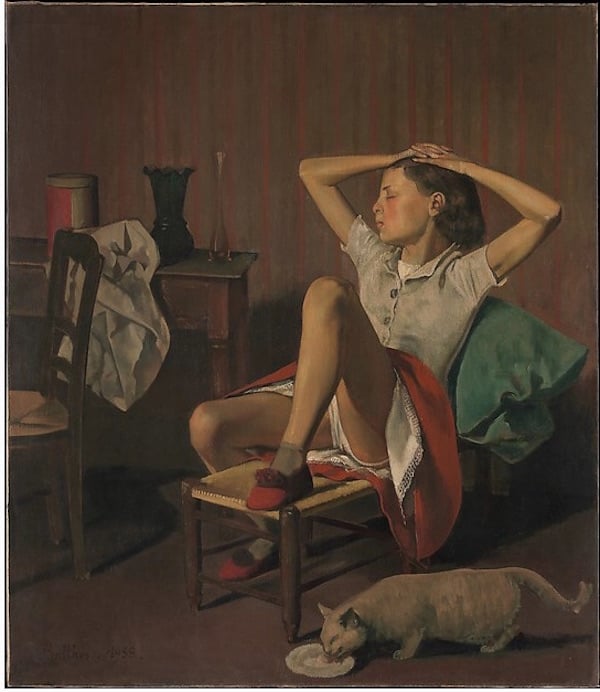
Met Says 'Suggestive' Balthus Painting Will Stay

Museum of Modern Art Online

National Gallery in London

National Gallery of Canada Online

Neanderthal Art the Oldest Ever Found

Prado Museum in Madrid

Rijksmuseum's ever-growing collection of over 300,000 Images 

Singing and the Silence: Birds in Contemporary Art 

Those Garish Greeks and Romans

Wander through the Machu Picchu Museum in Cusco, Peru

Wander Through the Royal Museum of Fine Arts in Antwerp 


Met Says 'Suggestive' Balthus Painting Will Stay


ArtNet Article:  

The Met Says ‘Suggestive’ Balthus Painting Will Stay After Petition for Its Removal Is Signed by Thousands...


Thursday, February 22, 2018

Neanderthal Art the Oldest Ever Found

The more we learn about Neanderthals, the more like us they seem and the less like the sub-human knuckle draggers of popular opinion...

Article From National Geographic: 

In a cave in Spain, scientists found this ladder shape made of red horizontal and vertical lines. The artwork dates to more than 64,000 years ago, suggesting it was created by Neanderthals.

The original research article:

This panel features the La Trampa pictorial group (21). (Inset) Crust sampled and analyzed for a minimum age (64.8 ka), which constrains the age of the red line. See (20) for details.

Scientific American:


Neanderthal Origin of Iberian Cave Art


Did Humans Make These Ancient Cave Paintings? | National Geographic


"Or was it Neanderthals? This question and others tantalize researchers investigating early paintings in some of Europe's caves. The paintings date back to a time when Neanderthals and early modern humans lived side by side."


CARTA: Evolutionary Origins of Art and Aesthetics: Neanderthal Art - Jean-Jacques Hublin

 
Renowned anthropologist Jean-Jacques Hublin explores the notion of art production by early human ancestors. Series: CARTA - Center for Academic Research and Training in Anthropogeny [Science] [Show ID: 16434]


Sunday, November 19, 2017

First Dogs in Art?

In Arabia, archaeologists have found what could be the earliest depictions of domesticated dogs...

 Original Article in the Journal of Anthropological Archaeology:


National Geographic Article:   

Video:  May be world's first images of dogs
- and they're wearing leashes...


Monday, November 13, 2017

Agate Sealstone Rewrites the History of Ancient Art


Agate Sealstone recovered from a Warrior's Tomb 
could rewrite the history of ancient art...


Science Channel Video on the discovery...

Archaeologists Find One Of The "Finest Works Of Prehistoric Greek Art Ever" In Griffin Warrior'


Jack Davis and Sharon Stocker, 
husband-and-wife archaeologists from the University of Cincinnati, discovered the warrior’s grave.
Sharon Stocker in the Warrior`s Tomb

More information on the amazing tomb and its contents...

Secrets of The Griffin Warrior 

Smithsonian Article...

This 3,500-Year-Old Greek Tomb Upended What We Thought We Knew About the Roots of Western Civilization  

National Geographic Article...

Rare Unlooted Grave of Wealthy Warrior Uncovered in Greece

Saturday, October 14, 2017

Imaginary Prisons of Piranesi

Carceri d'Invenzione (1745-1761) by Giovanni Battista Piranesi 


The imaginary prisons of Piranesi have haunted many (even some who had never seen them!) since they were etched in the 18th century. Here is a famous reference to them by Thomas de Quincy: 

   Many years ago, when I was looking over Piranesi's Antiquities of Rome, Mr Coleridge, who was standing by, described to me a set of plates by that artist, called his Dreams, and which record the scenery of his own visions during the delirium of a fever. Some of them (I describe only from memory of Mr Coleridge's account) represented vast Gothic halls: on the floor of which stood all sorts of engines and machinery, wheels, cables, pullies, levers, catapults,.&c. &c. expressive of enormous power put forth and resistance overcome. Creeping along the sides of the walls, you perceive a staircase: and upon it, groping his way upwards, was Piranesi himself: follow the stairs a little further, and you perceive it come to a sudden abrupt termination, without any balustrade, and allowing no step onwards to him who had reached the extremity, except into the depths below. Whatever is to become of poor Piranesi, you suppose, at least, that his labours must in some way terminate here. But raise you eyes, and behold a second flight of stairs still higher: on which again Piranesi is perceived, but this time standing on the very brink of the abyss. Again elevate your eye, and a still more aerial flight of stairs is beheld: and again is poor Piranesi busy on his aspiring labours: and so on, until the unfinished stairs and Piranesi both are lost in the upper gloom of the hall. -- With the same power of endless growth, and self-reproduction did my architecture proceed in dreams.
   Thomas de Quincy in Confessions of an English Opium Eater, 1821, p. 106


Related Links:
French site with excellent Piranesi images: http://piranesi.free.fr/carceri.htm

Here is an amazing animation by Gregoire Dupond at Factum Arte:


Giovanni Battista Piranesi: A video collection of 1088 etchings: