Sunday, March 8, 2020

Artists of the Book of Kells

In the second volume of her ground breaking and monumental study of Irish art, Francoise Henry examines the Book of Kells and distinguishes in it the work of four main artists.  This gives us a way to explore the various elements of illustration in the Book of Kells.


The first artist Francoise Henry calls The Goldsmith:

 One feels tempted to call him 'the Goldsmith', for his work at first sight seems wrought in precious metals, in enamel and niello. He composes a page by drawing a few wide patterns, the irregular shape of letters or the outline of the cross, in broad bands of golden yellow, silvery blue, purple or red. Inside these legible frames, out of them, around them, flows in a continuous stream a fantastic decoration of minute spirals endlessly interlocked with each other, animal bodies plaited and knit, snakes twisted into patterns of eight, little men so ingeniously folded and bent inside a circle that they look like geometrical figures gone crazy. The delicacy of his work is incredible.
(Irish Art II, p. 72)

What most consider the best and most distinctive of the Goldsmith's work is the Chi Rho Page (34r) and it does indeed give a sense of detailed metal work:
 

The second artist Francoise Henry calls the Portrait Painter:
  
  Another painter was the official portraitist of the Book. He made the two big figures of Evangelists, that of the teaching Christ and perhaps those of the symbols in square frames and the ‘Quoniam’ at the beginning of the Gospel of St Luke. He seems to have been trained in the same methods of ornamentation as the Goldsmith. He works as minutely when he chooses, but without the poetical meandering virtuosity of his colleague.(Irish Art II, p. 75)

What Francoise Henry calls the the portrait of the teaching Christ is usually now known as the Doubtful Portrait (32v) since experts are divided as to whether it is meant to represent Christ or is a misplaced portrait of one of the other evangelists:


The third artist, Francoise Henry calls the Illustrator.  Our previous artist, the Portrait Painter...

  cuts a rather tame figure beside the Illustrator, the wild, erratic painter who made the Arrest, the Temptation. the Virgin and Child, the ‘Tunc crucifixerant’ and probably the symbols at the beginning of St John’s Gospel. This artist does not pause much over the niceties of elaborate ornament. He cares nothing for beautiful architectural frames. He casually weaves a few ferocious-looking beasts in a border, twists luxurious branches sprouting out of a vase, sets two lions snarling at the keystone of an arch or on the side of a frame, and knots another one into the shape of a T.  His notion of colour sets one’s teeth on edge. (Irish Art II, p. 75)

The Illustrator provides the only appearance of the devil in the Book of Kells in the Temptation of Jesus at the Temple:


And indeed, the devil looks to have been burnt to a crisp in hellfire:


 One of the Illustrator's most famous works is The Virgin and Child (7v), which is considered to be the only such depiction to be found in the early gospel manuscripts:


 Francoise Henry gives no characterizing name to the fourth artist, but following her lead a later explorer of the Kells, Harry Ades, calls him the Joker:

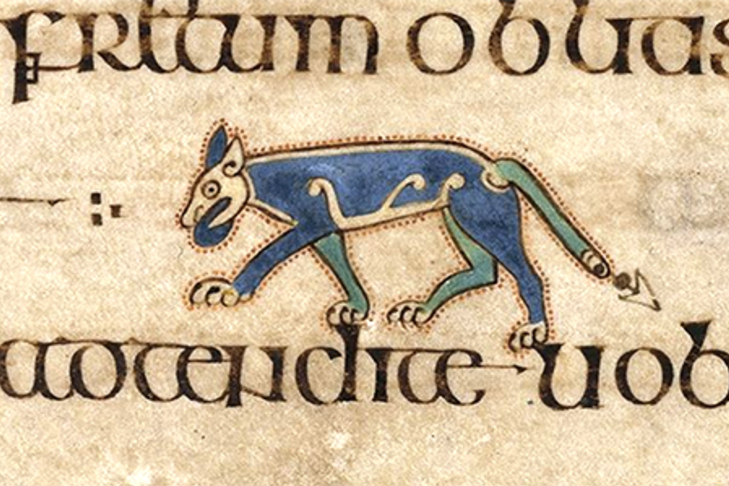
 Beside these chief painters, there is a very attractive fourth who has composed little more than one or two big pages...but who has displayed all his graceful fantasy and his dashing verve in many of the small capitals, in the cartouches of the text, in the border of the Genealogy, and in the animals drawn between the lines. He has certainly collaborated with the Goldsmith and added the little animal scenes in the big Chi-Rho page. He is a fastidious draughtsman. He combines a delightfully smiling sense of observation where shape is concerned with a breathless impetuosity in the description of movement. He sketches with a sharp pen cats, cocks and hens, a goat, a greyhound, all roaming through the pages, draws a horseman riding over a word, a warrior with a shield and spear sitting on a line, a cormorant nesting on top of a letter. Thanks to him there is a note of everyday life in that haughty universe of the Book of Kells.  (Irish Art II, p. 76)

The Joker is believed to have added such touches as the cat and mice (or some think kittens) on the Goldsmith's Chi Rho Page (34r)


He is also believed to have added some visual interest to the Genealogy of Jesus in the Gospel of Luke:  the whimsical totem pole of first letters of all the begats (Q  “Qui fuit”) and the soldier in the bottom right:  


Proceed to the next Book of Kells Post:  Exploring the Book of Kells Text

Friday, March 6, 2020

Exploring the Book of Kells

 At the beginning of the 20th century, one of the key books about the Book of Kells was the study by Sir Edward Sullivan (1920) which contained page prints of excellent quality for the time along with Sullivan's exuberant commentary.  This book is now in the public domain and is available to browse through or download at the Internet Archives:


Many people have contemplated the illuminations of the Book of Kells through Sullivan's book and found inspiration there.  James Joyce carried Sullivan's book all over Europe with him:


FutureLearn and Trinity College, Dublin provides an excellent page on 


Nowadays you can look at every page of the Book of Kells online and zoom in on all the details.  This amazing digital version is provided by the Manuscripts & Archives Research Library, Trinity College Dublin:


In studying the Book of Kells it is customary, as with most manuscripts, to refer to each physical page as a leaf or folio, and to distinguish the recto (or front) and the verso (or back) of the sheet.  So in looking at the online Book of Kells you have a number for each folio or physical page followed by an r or a v for recto or verso.

In our previous Kells post The Beautiful and Mysterious Book of Kells, we looked at the 67th page, called the Chi Rho Page.   For the online version, we would find this page called Folio 34r, meaning the recto or front of the 34th sheet:


We can zoom in on the cats and mice and save a fine quality image:


  If we zoom in on the Celtic interweave pattern near the top right of the page, we see that it has the head of a bird:


So Trinity College, Dublin has generously provided us with a fine tool for exploring the Book of Kells and making our own collection of images for personal viewing, both full page and zoomed in to intricate detail.

Here is an link to the set of books I found particularly helpful in my own exploration of the Book of Kells:

Ten Great Books about the Book of Kells


And here is a link to the...


Wednesday, March 4, 2020

The Beautiful and Mysterious Book of Kells


The Book of Kells is a medieval illuminated manuscript of the four gospels (primarily in the Latin or Vulgate translation of St Jerome) with many intricate, mysterious and mesmerizing illustrations such as the above 67th page, called the Chi Rho Page.  The quote below from the Topography of Ireland by Gerald of Wales (1185 AD) is believed by many to describe the Book of Kells and tells of the rewards of close examination:  


One of the mysteries of the Chi Rho page is the whimsical illustration of cats and mice near the bottom left:


It appears to show two mice nibbling on a communion wafer while two cats stand with paws on their tails and with two more mice on their backs!

The Book of Kells is filled with cats, mice and a wild variety of other creatures.  Here are examples of many of the creatures from the Book of Kells:

Animalia and Pages Ornaments from the Book of Kells


FutureLearn provides an entertaining and informative page on 


Geoff Swimer provides two short but excellent videos on...

Animals in The Book of Kells

 The animals in the Book of Kells are beautiful and varied. A brief introduction to the some of the different animals is followed by a look at the animals appearing in three of the full page illuminations. The 9th Century Columban monks of Iona illuminated the Gospels with Lions, peacocks, fish, snakes, wolves, cats, horses, Eagles and many more.


Cats and Peacocks in The Book of Kells


A more in depth video on the Book of Kells:


Monday, April 29, 2019

Sunday, January 13, 2019

The Art of Art Restoration and Conservation


Art History News has a fascinating archive of art restoration news both in print and video:


Art Restoration truly became a science in the 20th century.  
Professor Joyce Hill Stoner from the University of Delaware writes about the...

Changing Approaches in Art Conservation: 1925 to the Present


Modern Chemistry plays an important part in restoration and conservation.  See how nanoparticles, laser cleaning, and glue-eating bacteria restore valuable frescoes and paintings:

Modern Chemistry Techniques Save Ancient Art


The National Gallery of Canada has a team of a dozen restorers and conservators.  Watch them at work:

Restoration and Conservation at the National Gallery of Canada


A fascinating profile of art conservator Suzanne Siano:

One Painting at a Time


Baumgartner Restoration has some amazing videos about the art restoration process:


The amazing skills of art restoration are particularly appreciated where you see restorations badly done:


The Carnegie Museum of Art:  Go behind the scenes with chief conservator Ellen Baxter as she discusses the restoration process of a portrait of Isabella de' Medici:


 National Portrait Gallery, Smithsonian Institution:  After 18 months of careful conservation and analysis, Gilbert Stuart’s “Lansdowne” portrait of George Washington is back on view in the newly refurbished “America’s Presidents” gallery. 

Conservation of the “Lansdowne” Portrait of George Washington:

The Cathedral of Valencia and the restoration of the paintings there by Dr. Maria Gomez:


Not only paintings, but also drawings are restored. 
Watch a video showing the MET conservation of a Michelangelo drawing on loan from Christ Church Picture Gallery, Oxford:

 Art restoration sometimes means entire rooms!  The Damascus Room (1707) served as the reception area within a Syrian home of the Ottoman period. Extensive conservation and historical research were carried out by the Metropolitan Museum in preparation for the opening of the new galleries.

Conserving the Damascus Room at The Metropolitan Museum of Art:

Some restorations are mammoth and meticulous projects that go on for years, such as the restoration of the Sistine Chapel:


Monday, March 26, 2018

Index of Past Posts


Serpents of the Beatitudes: The Book of Kells Text, Part 2

Exploring the Book of Kells Text

Index to the Most Famous Pages of the Book of Kells

Artists of the Book of Kells

Exploring the Book of Kells

The Beautiful and Mysterious Book of Kells

The Great Cathedrals are Architectural Wonders

Agate Sealstone Rewrites the History of Ancient Art

The Art of Art Restoration and Conservation

Art Gallery of Ontario

Atlas at the Louvre, Paris

Elim Museum of Chinese Ancient Porcelain Art

Famous Artists Complete Works

First Dogs in Art?

Google Arts and Culture

Hermitage Museum in Saint Petersburg, Russia

Imaginary Prisons of Piranesi

Mathematics of Islamic Tiling Patterns

Met Museum Makes 375,000 Images Free

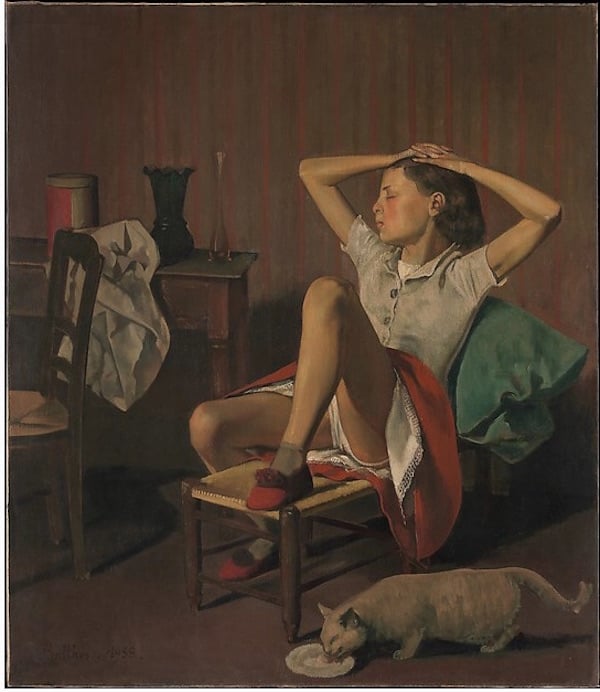
Met Says 'Suggestive' Balthus Painting Will Stay

Museum of Modern Art Online

National Gallery in London

National Gallery of Canada Online

Neanderthal Art the Oldest Ever Found

Prado Museum in Madrid

Rijksmuseum's ever-growing collection of over 300,000 Images 

Singing and the Silence: Birds in Contemporary Art 

Those Garish Greeks and Romans

Wander through the Machu Picchu Museum in Cusco, Peru

Wander Through the Royal Museum of Fine Arts in Antwerp 


Met Says 'Suggestive' Balthus Painting Will Stay


ArtNet Article:  

The Met Says ‘Suggestive’ Balthus Painting Will Stay After Petition for Its Removal Is Signed by Thousands...